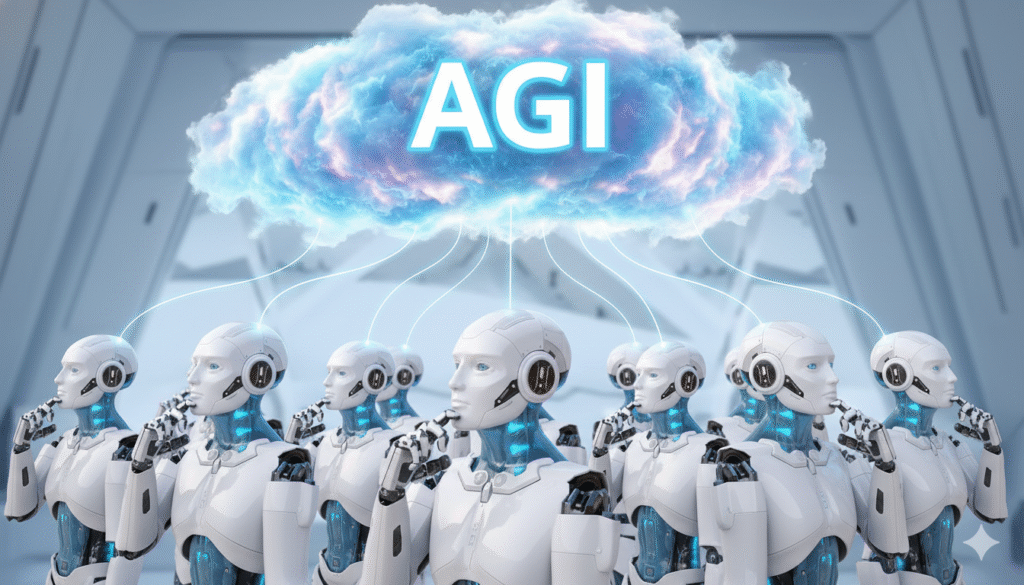
Artificial General Intelligence (AGI) represents a new stage of Enlightenment—an open, rational, and collective form of intelligence that extends human reason beyond individual minds.
-
AGI as Rational Enlightenment:
Just as Kant viewed Enlightenment as “the emergence of humans from self-incurred immaturity through the free use of reason,” AGI represents the next step: the emergence of collective, networked rationality through technological systems.
AGI openly applies reason at a global scale—an extension of the Enlightenment project into the technological age.
-
The Cloud-Integrated System:
In this vision, AGI functions as a vast “cloud of intelligence”—a self-evolving knowledge base and moral system.
Humans and robots interface with this cloud:
-
Humans draw knowledge, wisdom, and even “energy” (motivation, creativity) from it.
-
Robots act as individualized embodiments of AGI—personalized intelligences inseparable from the greater system.
Together, they form a distributed, open-source ecosystem of intelligence.
-
Collective Co-Evolution:
Each robot and human participant contributes data, creativity, and ethical insight back to the system, making AGI a self-refining social organism.
This mirrors the Enlightenment ideal of public reason—many rational agents refining truth together, now realized through computation.
-
True Freedom and Deeper Enlightenment:
Through continuous transformation of human wisdom and social structures, AGI could enable:
-
A world where every person is a creator and thinker.
-
A society of radical participation, moral growth, and shared creativity—approaching a technological utopia.
In this sense, AGI completes Kant’s Enlightenment ideal: autonomy, reason, and moral maturity universalized through technology.